







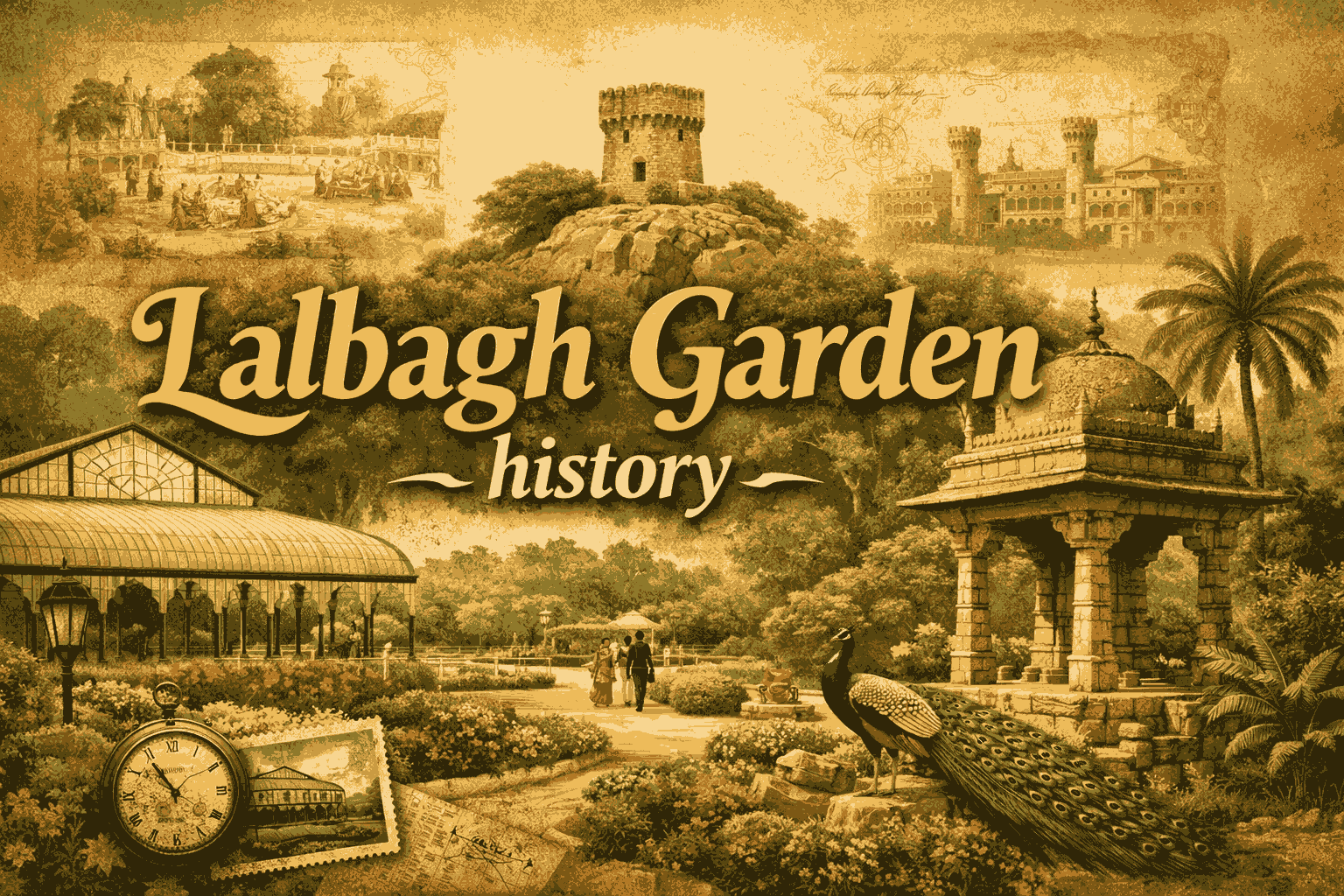
The history of Lalbagh Garden is, in many ways, the history of Bengaluru itself. The garden has outlasted empires, survived wars, changed hands between rulers and governments, and spent two and a half centuries quietly growing in the middle of one of India’s most rapidly changing cities. To walk through Lalbagh knowing something of its past is to see it completely differently.
The Beginning: Hyder Ali’s Garden (1760)
Lalbagh was founded in 1760 by Hyder Ali, the Muslim ruler of the Kingdom of Mysore. At the time, Bengaluru was a fortified garrison town, and Hyder Ali was transforming it into a proper capital. He chose a piece of land to the south of the city and ordered it to be developed as a pleasure garden — a tradition with deep roots in Mughal and Persian garden culture.

The name ‘Lalbagh’ — meaning ‘Red Garden’ in Urdu — is believed to refer to the red roses planted in the original garden, a signature of the Mughal garden aesthetic that Hyder Ali admired. The garden in its early years covered a relatively modest area, but it was already notable for its systematic planting and variety of specimens.
Expansion Under Tipu Sultan (1782–1799)
When Hyder Ali died in 1782, his son Tipu Sultan inherited both the kingdom and the garden. Tipu had a deep personal interest in botany and horticulture, and under his patronage Lalbagh was significantly expanded. He sent collectors to bring back plants from across Asia, the Middle East, and through trading contacts with European powers — particularly France, with whom he had close diplomatic relations.
Tipu planted trees from Afghanistan, Persia, and Southeast Asia alongside native South Indian species. He introduced systematic record-keeping of the plant collections, and some accounts suggest he personally oversaw certain plantings. Several trees in Lalbagh today are identified as dating to the Tipu Sultan era, including some of the garden’s most venerable specimens.
Tipu Sultan’s reign ended with his death in the Fourth Anglo-Mysore War of 1799, when British forces under General Harris stormed Seringapatam (Srirangapatna). Lalbagh passed into British hands.
British Control and Scientific Transformation (1799–1947)
Under British administration, Lalbagh shifted from a pleasure garden to a serious scientific institution. The East India Company placed it under the management of the Madras Botanical Gardens, and a succession of British horticulturists transformed its character.
Dr. Francis Buchanan (early 1800s): Conducted extensive botanical surveys and added documentation to the plant collection.
Dr. Robert Wight (1820s–1850s): Published landmark botanical works using Lalbagh as one of his primary research sites.
Dr. John Cameron (1874–1909): Often called the ‘father of Lalbagh,’ Cameron served as superintendent for 35 years and oversaw the garden’s greatest period of expansion. He added the Glass House, introduced the systematic tree labeling that still exists today, established the Rose Garden, and expanded the plant collection to several hundred species.
Cameron also introduced the idea of a public garden open to all residents — a progressive concept for colonial India. Under his influence, Lalbagh became a place where ordinary Bengalureans could walk, rest, and enjoy nature, not just a botanical research station for scientists.
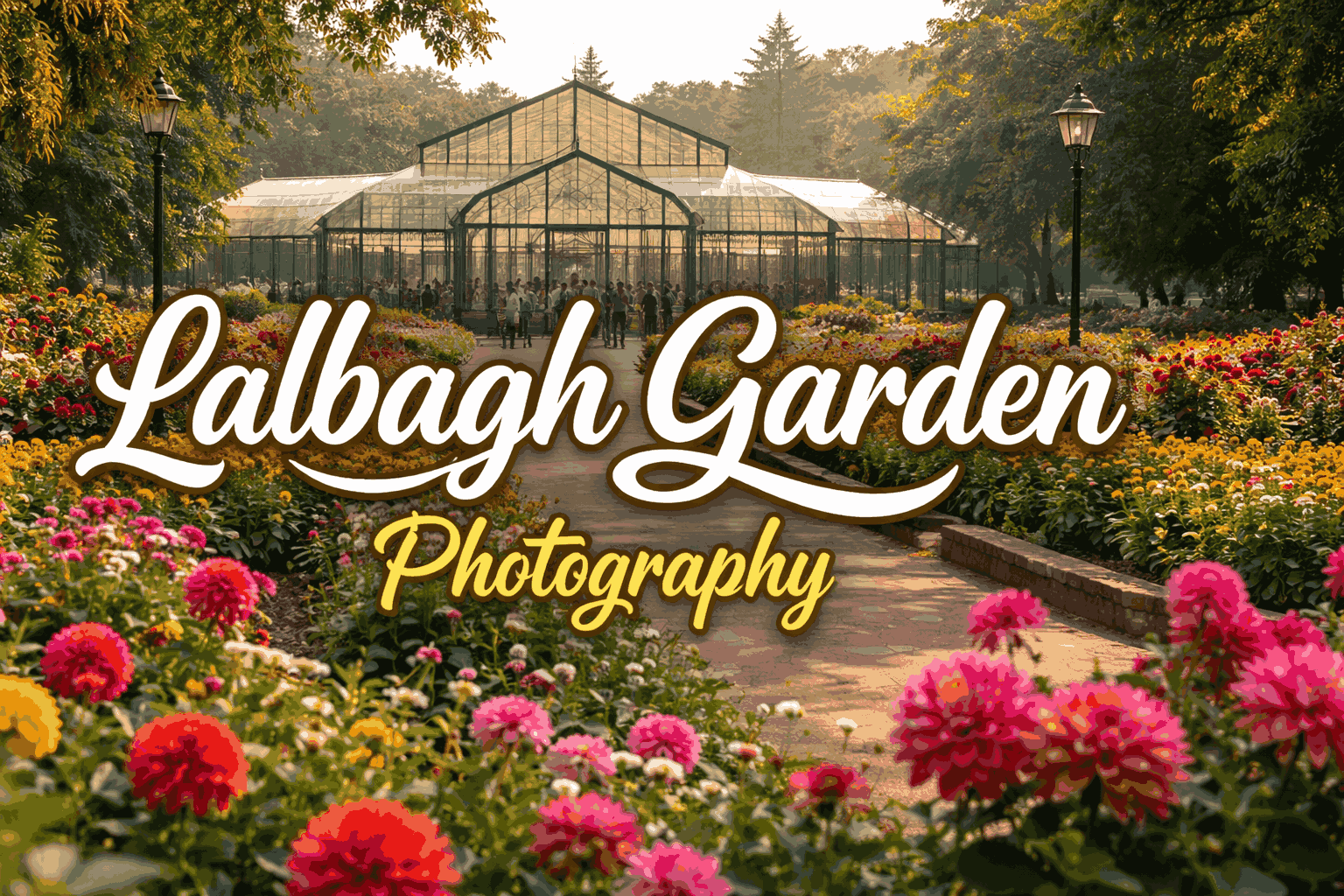
The Glass House, completed in 1889, was Cameron’s signature achievement. Designed by architects inspired by the Crystal Palace in Hyde Park, London (itself the venue of the Great Exhibition of 1851), it became the most recognizable structure in southern Bengaluru.
Post-Independence: The Garden Becomes a Public Institution
After Indian independence in 1947, Lalbagh was handed to the Karnataka state government and eventually came under the management of the Karnataka Horticulture Department, which oversees it today. The transition was significant — the garden moved from being a colonial scientific institution to a beloved public space for a free India’s citizens.
The flower shows, which had been held during the British era, were continued and expanded. The Republic Day and Independence Day timing was adopted to celebrate India’s national holidays, and the shows grew into major annual events drawing hundreds of thousands of visitors.
In 1971, Lalbagh was designated a Protected Monument under the Karnataka Ancient and Historical Monuments and Archaeological Sites and Remains Act — recognising it not just as a garden but as a place of cultural and historical significance.
The Heritage Trees of Lalbagh
One of the most significant developments in recent decades has been the formal recognition of Lalbagh’s oldest trees as heritage trees. Karnataka’s government has declared 49 trees in Lalbagh as protected heritage specimens — trees that cannot be felled even in the event of urban development or infrastructure work.
These include a Silk Cotton tree estimated to be over 200 years old, Rain Trees with canopies that spread over 30 meters, a massive Banyan tree believed to date to the Tipu Sultan era, and several species brought from Southeast Asia and the Pacific that are extremely rare in India.
The heritage tree program reflects a broader awareness that Lalbagh is not just a recreational space but a living museum — a collection of botanical specimens assembled by some of history’s most important gardeners.
Lalbagh Today
Today, Lalbagh covers 240 acres and contains over 1,000 plant species. It receives an estimated 4 to 6 million visitors per year, making it one of the most visited public gardens in India. The garden is managed by a large team of horticulturists, botanists, and ground staff who maintain everything from the flower beds to the 200-year-old trees.
It faces the challenges that all urban green spaces face — the pressure of a rapidly growing city, pollution, encroachment, and the demands of millions of visitors. But it has survived wars, conquests, and the transformation of Bengaluru from a small garrison town to a metropolis of 12 million people. Two and a half centuries of continuous growth is a remarkable record.
For the visitor walking through the garden today, all of this history is present — in the girth of the oldest trees, in the Victorian ironwork of the Glass House, in the roses that trace a line back to Hyder Ali’s original plantings. Lalbagh is worth knowing deeply.