








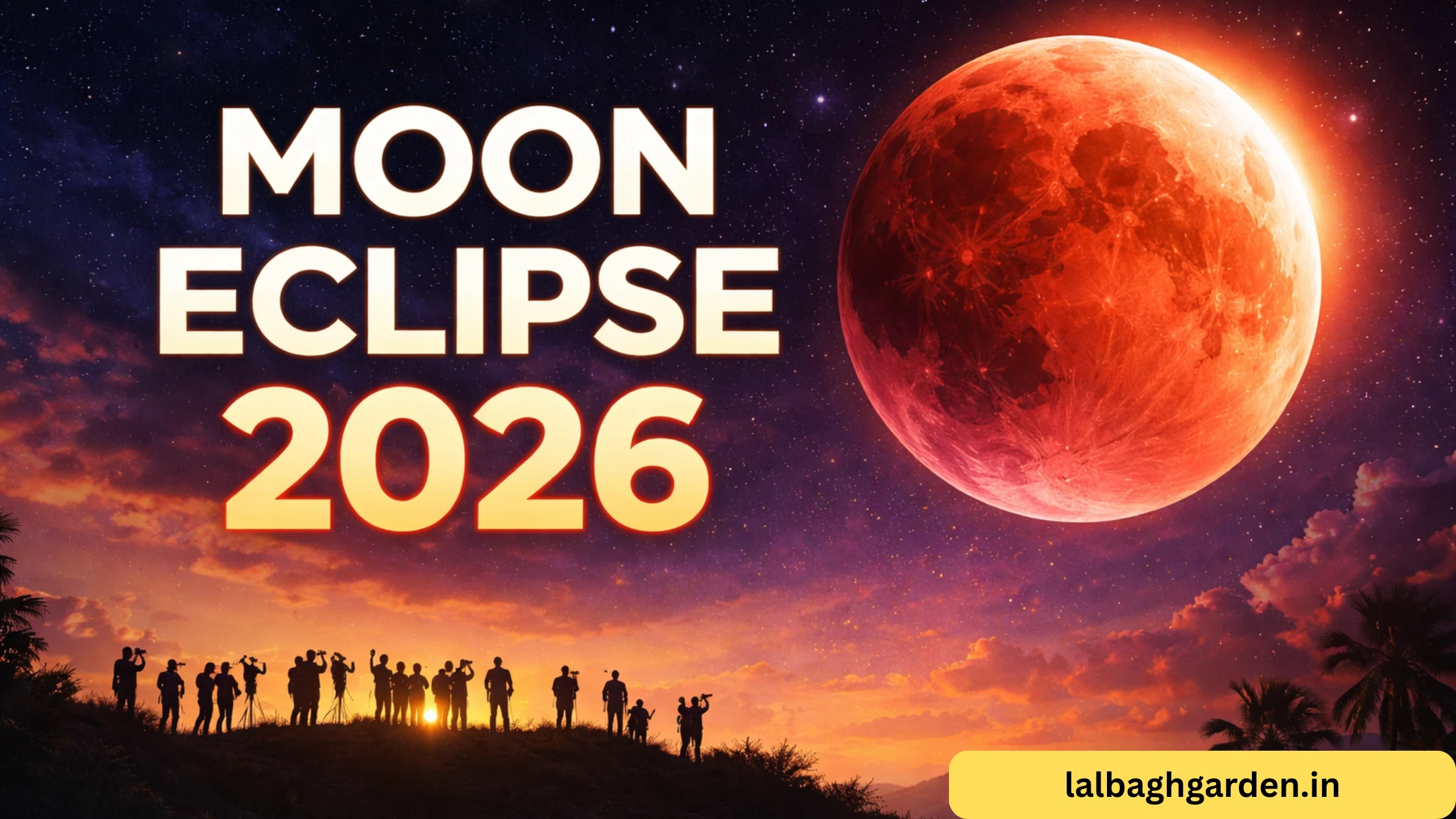
New Delhi, India — March 3, 2026 — Astronomy lovers and sky watchers across the country are gearing up for one of the year’s most spectacular celestial events — the Total Lunar Eclipse of 2026, popularly known in India as Chandra Grahan. This rare astronomical phenomenon is making headlines because it coincides with the festival of Holi this year, creating a unique blend of scientific wonder and cultural significance.
📅 Date & Timing (India Standard Time)
According to astronomical data and official updates:
- Date: Tuesday, March 3, 2026
- Eclipse Begins: 3:20 PM IST
- Total Phase Begins: 4:34 PM IST
- Total Phase Ends: 5:33 PM IST
- Eclipse Ends: 6:47 – 6:48 PM IST
- Best Viewing Window in India: Approximately 6:33 PM to 6:40 PM IST after moonrise
The entire eclipse — from the penumbral stage (when the Earth’s outer shadow begins touching the Moon) to the final phase — will span over five hours, but only the last part will be visible from most parts of India because the Moon will rise late in the evening.
🌍 What Is a Total Lunar Eclipse?
A total lunar eclipse happens when Earth comes directly between the Sun and the Moon, blocking direct sunlight from reaching the lunar surface. As sunlight filters through Earth’s atmosphere, only red wavelengths reach the Moon, making it appear reddish or coppery — a sight often called a “Blood Moon.”
This 2026 eclipse has a significant magnitude of about 1.15, indicating it’s a deep coverage event where the Moon enters fully into Earth’s darkest shadow (the umbra).
🧭 Visibility Across India
While the lunar eclipse itself is visible globally (from places like Eastern Asia, Australia, and the Americas), conditions vary across the Indian subcontinent:
- Northeastern states (like Assam, Arunachal Pradesh, Meghalaya) and the Andaman & Nicobar Islands stand a better chance of seeing the totality phase before moonrise.
- In most of North, West and Central India (Delhi, Mumbai, Bengaluru, Chennai, Pune, etc.), only the later stages and the reddish partial glow will be visible after the Moon appears above the horizon around sunset.
- In cities like Hyderabad, observers may only catch a faint partially eclipsed moon due to late moonrise timing.
📈 Unique Aspects of This Chandra Grahan
🎉 Coincides with Holi
For the first time in decades, the total lunar eclipse coincides with Holi, the festival of colours. This overlap has led to cultural discussions on rituals, timings for Holika Dahan, and local observances, especially given the traditional importance of the full moon (Purnima) in Hindu calendars.
🔭 Rare “Blood Moon” Phase
During totality, the Moon may showcase a striking reddish hue — a phenomenon that stargazers and astrophotographers call a Blood Moon. While only partial viewing will be possible in India, globally the event promises a dramatic appearance.
📍 How to Watch Safely
- A lunar eclipse is safe to view with the naked eye, unlike solar eclipses. No special glasses are required.
- If weather permits, positioned away from city lights with a clear view of the eastern horizon after 6:20 PM IST will give the best chance of spotting the eclipse’s final moments.
- Binoculars or a small telescope can enhance visibility of the moon’s colour and shadow dynamics.
🪐 Quick Facts
| Feature | Details |
|---|---|
| Type of Eclipse | Total Lunar Eclipse (Chandra Grahan) |
| Date | March 3, 2026 |
| Peak Viewing in India | ~6:33 PM to 6:40 PM IST |
| Eclipse Magnitude | ~1.15 |
| Best Visibility | Northeast India, Andaman & Nicobar Islands |
| Unique Moment | Coincides with Holi festival |
| Safe to View | Yes (no eye protection needed) |
📷 What to Expect
This eclipse is expected to be one of the most photographed and widely discussed lunar events of 2026 — with enthusiasts sharing images of the reddish Moon, cultural celebrations, and family gatherings across the country. Clear skies and minimal light pollution will elevate the viewing experience, especially in rural and elevated regions.
Conclusion: The Moon Eclipse 2026 — or Chandra Grahan — is not just an astronomical event but a cultural moment for India. Whether you are interested in science, photography, astrology, or traditional beliefs, this event offers multiple layers of significance. Mark your calendars for March 3, 2026, and step outside around 6:30 PM IST to witness the celestial spectacle.